
The downstairs tub in a Decatur area home rarely gives much warning. One morning it drains a little slowly, a week later it gurgles when the washing machine empties, and then on some Sunday it fills with gray water that nobody poured into it. That water is coming up from the sewer lateral, the single pipe that carries everything out of the house, under the yard and into the public main near the street. In most DeKalb County neighborhoods, that pipe sits in conditions that are hard on it in ways homeowners seldom picture.
When it is time to have someone look at that line, CJ Plumbing is a Decatur based team of licensed and insured plumbers whose work ranges from small repairs to complete system installations. They quote for free and take bookings online on weekdays, which makes a first conversation about a slow drain easy to start.
What follows traces that hidden pipe from the foundation wall out to the street, because understanding the route makes the warning signs and the repair choices far less mysterious.
Where the Line Leaves the House
Every lateral begins at the point where the home’s drains merge into one larger pipe, usually four inches across. Somewhere near that junction there should be a cleanout, a capped access pipe that lets a plumber send a camera or cable into the line without pulling a toilet. In many older ranch houses around Decatur, Tucker and south DeKalb, that cleanout was buried under mulch, paved over by a patio, or never installed at all.
Finding it is worth an afternoon. A homeowner who knows where the cleanout sits can save a technician real time during a backup, and adding one where none exists is a modest job that pays off every time the line needs attention afterward. It is also worth knowing that the section of pipe on private property is generally the owner’s responsibility, not the county’s, so problems between the house and the main tend to land on the homeowner’s bill.
Georgia Clay Never Really Sits Still
The red clay that stains every pair of sneakers in the Atlanta region has a habit that matters underground. It swells when it soaks up water and shrinks as it dries out. A wet winter followed by a hot, dry August means the soil around a buried pipe is constantly pushing and then letting go.
Over decades, that movement shifts sections of pipe out of alignment. Joints open slightly, and low spots called bellies form where the pipe sags. Water and waste settle in a belly instead of flowing past, and solids slowly build up there. A house can have perfectly clean interior drains and still back up because of a dip sixty feet out in the front yard.
The Trees Everyone Loves Want That Water Too
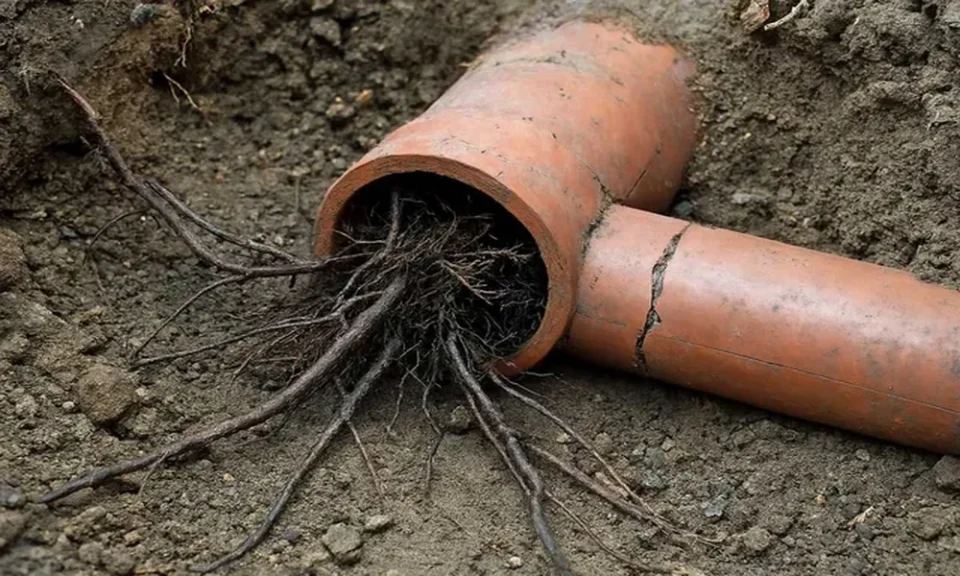
Decatur is proud of its canopy, and the willow oaks, water oaks and sweetgums that shade its streets are a big reason the area feels the way it does. Their roots, though, travel far beyond the drip line in search of moisture, and a warm, nutrient rich sewer line is about as appealing a target as they will find.
Roots rarely break a sound pipe. They slip through tiny gaps at joints, often the very gaps that shifting clay created, and then thicken inside. What starts as a hairlike strand becomes a mat that catches paper and grease. This is why root problems so often show up in clusters of homes on tree lined blocks built in the same era.
What the Pipe Is Made of Changes Everything
The age of a house usually hints at the material underground, and that material shapes both the failure pattern and the fix.
- Clay tile, common in homes built before the 1950s, resists corrosion well but has many joints that roots love to exploit.
- Orangeburg pipe, a tar soaked fiber material used roughly from the late 1940s into the 1970s, tends to soften, blister and flatten with age, and plumbers generally treat it as something to replace rather than repair.
- Cast iron handles weight well but rusts from the inside, leaving rough scale that snags waste and eventually cracks.
- PVC, standard in newer construction and most replacements, is smooth and has tightly glued joints, though it can still be pulled out of line by settling soil.
Plenty of Decatur area homes have a mix, with PVC near the house from a past remodel and original clay or Orangeburg running out to the street.
How a Struggling Line Announces Itself
Sewer trouble tends to show up at the lowest fixture first, often a basement floor drain, a ground floor shower or a tub. A single slow sink usually points to a local clog, but several fixtures slowing at once points further downstream.
Other clues worth noticing include gurgling from a toilet when a nearby sink drains, a faint sewer smell outdoors near the cleanout, and a stripe of grass that stays unusually green and lush in a dry spell. That stripe can mean the line is leaking and quietly fertilizing the lawn above it. Recurring backups that clear up after a drain service and then return within a few months are a strong sign that roots or a belly are the real cause.
Repairs Look Very Different Now
Not long ago, fixing a lateral meant digging a trench across the whole yard. A camera inspection now comes first, showing exactly where roots, cracks or sags sit and how deep the line runs. That footage often turns a vague worry into a specific, smaller job.
From there, options depend on what the camera shows. Hydro jetting uses high pressure water to scour out roots and grease buildup, far more thoroughly than a cable. When the pipe is structurally weak but still in its original path, trenchless lining can create a new pipe inside the old one through a cleanout or small access hole. Pipe bursting pulls a new line through while fracturing the old one outward. And where a belly or collapsed section is the problem, digging up just that spot is sometimes the most sensible answer. Saving a mature oak and a finished driveway is often what makes the trenchless methods worth weighing.
Habits That Buy the Line More Years
A few routines go a long way in clay heavy, tree filled neighborhoods. Keep cooking grease out of the sink and let it harden in a can instead. Treat so called flushable wipes as trash, since they do not break down the way toilet paper does. When planting new trees, keep them well away from the line’s path. Homes with older clay or Orangeburg pipe benefit from a camera check every few years, especially before buying, since a sewer scope is rarely part of a standard home inspection.
The lateral is the least glamorous pipe a house owns, but in Decatur’s moving soil and under its thirsty trees, a little attention to it now usually costs far less than the morning it decides to send everything back up into the tub.
