
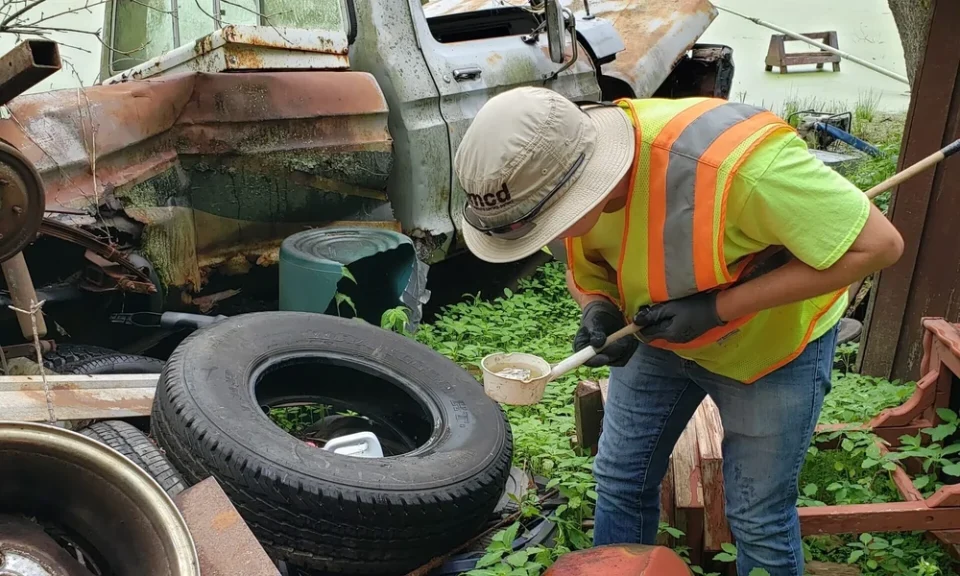
If your yard still swarms with mosquitoes even though you have no pond or pool, the source is probably closer than you think. Mosquitoes lay their eggs in standing water, and in summer heat the CDC notes that some species can go from egg to biting adult in about a week. The Asian tiger mosquito, now common across Missouri, breeds in tiny amounts of water, sometimes no more than a bottle cap holds. Here are ten spots our Kansas City pest control technicians check first, and how to deal with each one.
1. Can clogged gutters breed mosquitoes?
Yes. Leaves and seed pods from maples and oaks build up in gutters and hold shallow pools of water that you cannot see from the ground. Clean the gutters in late spring and again in fall, and check that downspouts drain freely.
2. What about flowerpot saucers?
Saucers under potted plants are one of the most common breeding spots. Empty them after watering or rain, or fill them with sand so water drains in without pooling on top.
3. Why do tarps and covers matter?
Tarps over woodpiles, grill covers, and boat or pool covers form folds that hold rainwater for days. Pull them tight so water runs off, or turn them over after storms.
4. Could kids’ toys be the problem?
Often. Buckets, toy trucks, sandbox lids, and wheelbarrows left upright all collect water. The Asian tiger mosquito lays eggs just above the waterline, and the CDC notes those eggs can survive dry for months. So scrub containers out before refilling them instead of just tipping them over.
5. Why are old tires such a problem?
A tire’s curved inside holds water that is shaded and warm, and it is very hard to empty fully. Recycle old tires. For a tire swing, drill a few drainage holes in the bottom.
6. How often should birdbaths and pet bowls be changed?
At least once a week, and more often in July and August. The CDC recommends emptying and scrubbing water-holding items weekly, because a week is about how long some mosquitoes need to develop. Rinsing a birdbath with the hose every few days also helps.
7. Are rain barrels safe to keep?
Yes, if they are sealed. Cover every opening, including the overflow, with fine mesh screen. For water you cannot screen or empty, mosquito dunks made with Bti (Bacillus thuringiensis israelensis) are an EPA-registered larvicide that kills mosquito larvae without harming pets, birds, or plants when used according to the label.
8. Can trees breed mosquitoes?
Yes. Rot holes in tree trunks and hollow stumps fill with rainwater and leaf debris, which makes them a natural breeding spot that few people think to check. Fill old stumps with soil or sand. For a hole in a living tree, ask an arborist before filling it, and treat it with Bti in the meantime.
9. What about corrugated downspout extensions?
The flexible black drain pipes many Kansas City homes use to carry water away from the foundation have ridges inside that trap water long after a storm. Replace them with a smooth-walled pipe, or make sure they slope enough to drain completely.
10. Is an unused pool or garden pond a risk?
A neglected pool, a covered hot tub, or an ornamental pond with no moving water can produce a large number of mosquitoes. Keep pools chlorinated and filtered, drain water from covers, and add a pump or fountain to keep pond water moving. Stagnant, organic-rich water like this is where Culex mosquitoes breed, and in Missouri, Culex mosquitoes are the main carriers of West Nile virus.
When should you call Zip Zap Pest for Kansas City pest control?
Cleaning up standing water reduces mosquitoes, but neighboring yards, creeks, and drainage ditches can keep supplying new ones. Zip Zap Pest offers mosquito control for homes across Kansas City and the Northland, and mosquitoes are included in some of its year-round bundle plans. ZipZap Termite & Pest Control is family-owned, based in Lawson, and QualityPro certified. It is led by Jeff Preece, a Board-Certified Entomologist who also holds a Public Health Entomology Certificate.
What’s the simplest way to cut down on backyard mosquitoes?
Walk your yard once a week from spring through fall and dump, scrub, cover, or treat anything holding water. Gutters, saucers, tarps, tires, and drain pipes are the spots people miss most. Small, steady habits make a noticeable difference by midsummer. If mosquitoes still keep you indoors, a Kansas City pest control professional can find the breeding spots you cannot see and help you reclaim your yard next season.
